The Ship’s Becalming
The Rime of the Ancient MarinerThe Ship’s Becalming is the sudden collapse of forward motion that transforms a voyage into a scene of confinement and deprivation. After a fair breeze carries the ship into a previously silent sea, the wind drops, the sails fall, and the crew are left under a fixed, burning sun. Water fills the view but offers no drink. The ship’s stillness is at once a physical emergency and the setting in which the killing of the Albatross becomes an accusation borne visibly by the Ancient Mariner.
From Fair Passage to Stillness
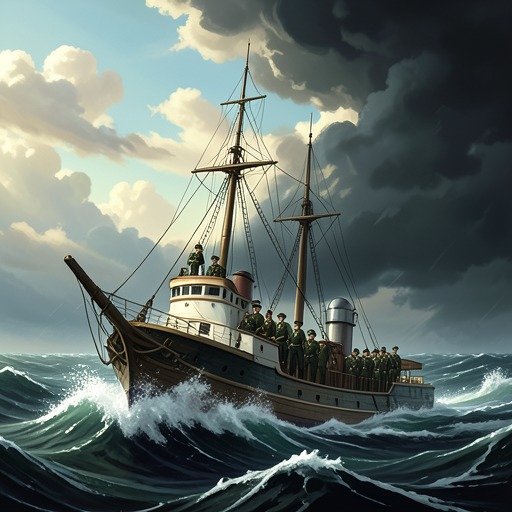
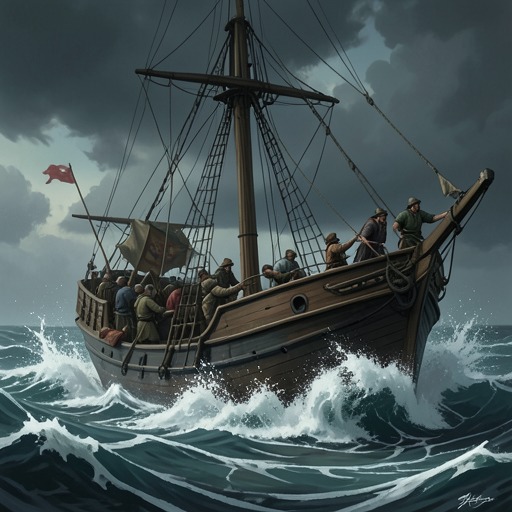
The becalming follows a period of apparent progress. The ship leaves harbour with its crew aboard and, after the storm has driven it south, encounters mist, snow, and mast-high ice. A south wind later rises behind the ship, and the Albatross follows it. Once the ice breaks and the vessel enters open water, a fair breeze drives it onward, white foam flies, and the wake follows freely. The crew reach a sea described as silent and unprecedented in their experience.
That release does not last. The breeze dies; the sails drop, and the crew speak only to break the sea’s silence. The abrupt change reverses the promise of the fair passage: the open sea no longer enables travel, and the vessel loses the wind on which its movement depends. The contrast between the ship’s swift flight under the storm and its later helpless stillness makes the becalming a decisive change in the voyage, rather than merely another stretch of difficult weather.
Heat, Thirst, and the Crew’s Ordeal
The ship is immobilized beneath a hot, copper-colored sky. At noon, the bloody Sun stands directly above the mast, appearing no bigger than the Moon. The image fixes the crew beneath a glaring overhead presence while also making the familiar sky seem strange and oppressive. Day follows day without breath or motion: the ship is as idle as a painted ship on a painted ocean, an image that reduces a working vessel to a still picture.
The crisis sharpens into thirst. Water is everywhere around the ship, yet the crew cannot drink it; meanwhile, the boards shrink. The juxtaposition makes abundance itself cruel: the sea surrounds the thirsty sailors but cannot sustain them. This is not simply a lack of motion but a narrowing of the crew’s means of survival, as heat, stillness, and thirst reinforce one another. The ship remains afloat in a world of water while the people aboard suffer for want of drink.
The Albatross as a Mark of Guilt
The becalming follows the Ancient Mariner’s shooting of the Albatross. The crew had accepted the killing, saying that such birds rightly deserved to be slain because they brought fog and mist. The ship’s earlier progress under a fair breeze might appear to confirm their judgment, but the sudden stillness overturns that confidence: the voyage that seemed to resume freely is arrested, and the crew’s explanation no longer offers security.
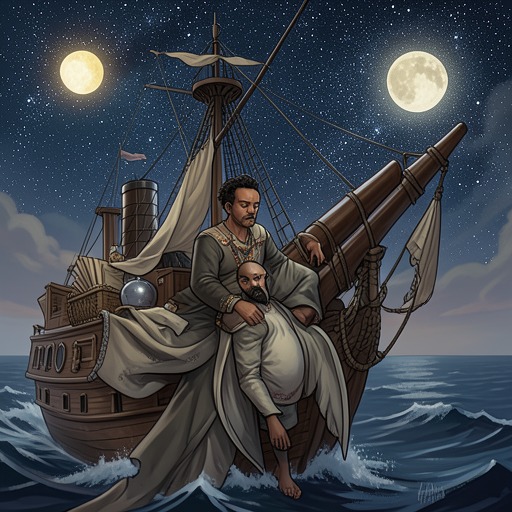
The Ancient Mariner recalls the hostile looks he received from both old and young. Instead of a cross, the Albatross is hung around his neck. That substitution turns the bird into a public sign of the act and its burden, and places the sailor’s guilt within the crew’s shared ordeal. The becalming therefore joins a material predicament to a visible moral consequence: the vessel cannot advance, while the dead bird remains attached to the man who killed it.
Consequences and Narrative Significance
The still sea establishes the conditions for the poem’s extended ordeal: the Ancient Mariner is left alone on a wide sea, and for seven days and seven nights he sees the curse without being able to die. These later details deepen the becalming’s significance as the beginning of prolonged confinement, not a brief interruption in sailing. The absence of wind makes ordinary navigation impossible and leaves the crew exposed to the sea’s heat and silence.
The episode also makes movement a measure of the voyage’s changing fortunes. Earlier, the ship is driven south by the Storm-Blast; then the south wind rises behind it, and the crew pass through the ice. In the becalming, sails hang down and the ship becomes an image of arrested passage. Much later, the helmsman steers and the ship moves on despite there being no breeze, a supernatural resumption that recalls the earlier loss of natural motion. The becalming’s force lies in this contrast: windless movement can return, but the helpless stillness first reveals how little control the crew possess over their passage or its consequences.
When the Ancient Mariner eventually hears the dash of oars and the Pilot’s cheer, the sound marks an approach from outside the becalmed voyage. The remembered ordeal has by then become part of the story he tells the Wedding-Guest. Its central image remains starkly unresolved: water surrounds the ship, the boards shrink, and the crew cannot drink. The vessel’s stillness gives the Albatross’s death a setting in which neither forward progress nor the sea’s apparent abundance can undo what has happened.